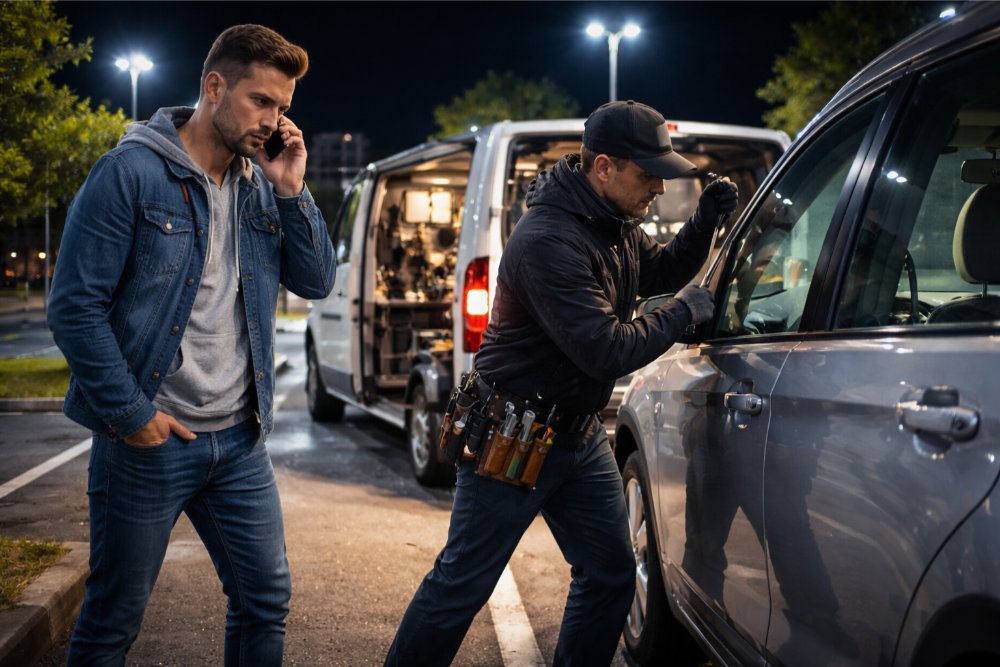
The First Minutes Matter
The moment you realize your car door will not open, the night feels different. Quieter, heavier, less friendly. I have seen people go from calm to panicked in under ten seconds, and that reaction is more dangerous than the lockout itself. Your first job is not the door. It is your surroundings. Take a breath, look around, and understand where you are. A well-lit parking lot near open businesses is one situation. A dark roadside shoulder or empty residential street is another. Your safety comes before the vehicle, always.
Late at night, visibility drops and risk rises. Fewer people are around to help, but the few who are present can see you clearly if you are struggling, frustrated, or distracted. Stand upright, keep your phone in hand, and avoid turning your back to open space for long periods. If you feel exposed, move to a brighter area even if it means leaving the car locked. Modern vehicles can handle being parked overnight far better than a person can handle a risky environment. Cars are replaceable. You are not.
I often tell drivers that those first two minutes shape everything that follows. If you slow down, assess, and act deliberately, the problem stays small. If you start pulling on handles, peering through windows, or trying random tricks you saw online, you attract attention and waste energy. A locked car is an inconvenience. A distracted person at night can become a target. Stay aware. Stay visible. Stay in control of the situation rather than letting it control you.
Stay Safe First
Your physical position matters more than people think. Do not crouch beside the door or kneel near the wheel as if you are working on the car. That posture limits your view and makes you look vulnerable. Stand, keep your head up, and maintain a clear line of sight in all directions. If you are on the roadside, step away from traffic. Night drivers have reduced reaction time, and a vehicle drifting slightly can turn a small problem into an emergency.
If you have a phone, use it strategically. Turn on the screen light, but do not bury your face in it. Send a quick message to someone you trust with your location. That small step changes your mindset; you are no longer alone in the situation. If the area feels unsafe, call local non-emergency police services and explain that you are locked out and concerned about your location. In many Canadian cities, officers can check on you or stay aware of the situation. It is not overreacting. It is smart risk management.
Cold weather adds another layer. Canadian nights can become dangerous quickly, especially in winter. Even above freezing, long exposure while standing still cools the body fast. If you are dressed lightly, seek shelter nearby while arranging help. A 24-hour café, gas station, or hotel lobby is far safer than waiting beside the car. Vehicles can sit for hours without harm. The human body cannot. I have seen mild discomfort turn into shaking hands and poor decisions simply because someone tried to “tough it out” in the cold.
Check the Obvious
Once you are safe and thinking clearly, then you can focus on the car. Start simple. Walk around the vehicle and check every door, including the trunk or hatch. It sounds basic, but people under stress often test only the driver’s door. Rear doors sometimes remain unlocked, especially if someone exited recently. Do not rush. Test each handle firmly but without force. You are checking, not trying to break in.
Look through the windows carefully. Keys on the seat are one scenario. Keys in the ignition or cup holder are another. If the keys are visible, that information helps the locksmith later. If they are not, they may be in the trunk, a pocket, or lost entirely. Also check for signs that the vehicle automatically relocked. Some modern cars lock themselves after a short time if no door is opened. That feature catches people off guard more often than you would think.
If you use a key fob, try it again after stepping a few metres away and then closer. Interference from other electronic devices or low battery power can affect signal strength. This is a real, documented issue with remote systems. Press the unlock button slowly, not repeatedly. Rapid pressing does not help and can sometimes cause the system to pause briefly. If nothing changes, accept that the electronic entry is not working right now. That is useful information, not a failure on your part.
Avoid Risky Tricks
At this point, the temptation to improvise kicks in. People remember movies, old stories, or internet videos showing doors opened with wires, shoelaces, or plastic strips. Modern vehicles are different. Door mechanisms are shielded, electronic, and integrated with anti-theft systems. Forcing tools into the door frame often damages weather seals, scratches paint, or bends the metal. The repair cost can exceed what professional unlocking would have been in the first place.
Airbags inside the door panels add another concern. While they are designed to deploy in specific crash conditions, random pressure and prying near sensors is not something you want to experiment with. There is also the risk of triggering the alarm system, which draws attention and increases stress. In some cases, repeated incorrect attempts can even cause the vehicle to disable certain functions temporarily. Manufacturers build these systems to resist tampering, not to be opened with household items.
There is also a legal angle that people forget. Trying to break into a car, even your own, can look suspicious to bystanders or security. Someone may call police thinking a theft is in progress. Explaining the situation is possible, but it adds time and tension you do not need. I always say this clearly: if you are not trained and equipped, do not try to defeat a modern car lock yourself. You are far more likely to create a bigger, more expensive problem than to solve the original one.
Call the Right Help
This is where professional help becomes the smart move, not a last resort. Automotive locksmiths are trained to open vehicles without damage using specialized tools and up-to-date knowledge of lock systems. They deal with electronic keys, transponders, and modern security designs every day. What looks impossible to a driver is routine work to someone in the field. The difference is not strength. It is method and experience.
When you call, provide clear information. Your location, the vehicle make and model, and whether the keys are inside all matter. This allows the locksmith to bring the right tools. In a city like Kitchener, where weather and traffic can complicate night calls, choosing a reliable service makes a real difference. A professional resource such as a 24 hour locksmith kitchener can respond at any time, which is exactly what you need when the problem does not wait for business hours.
People sometimes hesitate because they worry about cost. I understand that. But compare it realistically. Damaging a door seal, window, or lock cylinder through DIY attempts can cost far more than a standard unlock service. There is also the value of time and safety. Standing in the dark for an extra hour because you tried shortcuts is not saving money. It is increasing risk. A qualified locksmith resolves the situation efficiently, and you can move on with your night instead of escalating the problem.
What Happens During Service
When the locksmith arrives, the process is usually calm and methodical. First comes identification. A legitimate professional will confirm that you are the vehicle owner or have the right to access it. This protects everyone involved and is standard practice in Canada. You may be asked for ID and vehicle documents if available. It might feel formal in the middle of the night, but it prevents misuse of the service and keeps the industry reputable.
Next comes the assessment of the vehicle itself. Different makes and models require different entry methods. Some doors are best accessed through the top frame using controlled air wedges and specialized tools. Others are safer to approach through different points that reduce stress on the door structure. The goal is always the same: unlock the vehicle without damage. A trained automotive locksmith works slowly and precisely. Quick does not mean rushed. It means efficient without cutting corners.
If the issue involves a key fob failure or lost key rather than a simple lockout, the process may include key cutting or programming. Many modern cars use transponder chips that must be matched to the vehicle’s immobilizer system. This is technical work, done with dedicated equipment. It is not guesswork. Watching the process often reassures drivers because they see the care taken to avoid harm to the vehicle’s electronics and bodywork.
Understanding Modern Locks
Car locks today are part of a broader security system, not just a piece of metal. Mechanical components work together with electronic modules, sensors, and software. This is why older methods that worked decades ago no longer apply. Vehicles are designed to resist forced entry, and that design protects owners from theft but complicates accidental lockouts. It is a trade-off most drivers are happy to accept, even if they curse it for a few minutes on a cold night.
Keyless entry systems add convenience but also new failure points. A weak battery in the fob, signal interference, or even extreme cold can reduce performance. This does not mean the system is faulty; it means electronics have limits. Knowing this helps you react calmly. Replacing the fob battery regularly and keeping a spare accessible at home are small habits that prevent many late-night calls. Technology is reliable, but not magical.
Transponder keys and immobilizers also mean that copying a key is no longer a simple hardware store job. The chip must be programmed to the vehicle. That is why professional locksmiths invest heavily in tools and training. They stay current with evolving models and security updates. When you call for help, you are not just paying for someone to open a door. You are using specialized knowledge that matches the complexity of modern vehicles.
Managing Stress in the Moment
Being locked out at night triggers a very human response. Your heart rate rises, your mind jumps ahead to worst-case scenarios, and small decisions feel urgent. Recognizing that reaction helps you manage it. Pause. Breathe slowly. Remind yourself that this is a solvable problem, not a crisis. I have seen drivers make smart choices simply because they took ten seconds to settle their thoughts before acting.
Talking to someone while you wait also helps. A short call to a friend or family member provides perspective. You explain the situation, and in doing so, you hear how manageable it sounds. That shift reduces impulsive behaviour like trying to force the door or wandering into unsafe areas. Emotional regulation is not just psychological advice. It directly affects physical safety in situations like this.
There is also relief in handing the problem to a professional. Once the call is made and help is on the way, your role changes. You are no longer the one who must solve the lockout. You simply stay safe and available. That mental handover reduces tension significantly. Many people tell me the hardest part was not the locked door but the uncertainty before they called for assistance.
After You Are Back Inside
When the door opens, resist the urge to rush off immediately. Take a minute. Check that everything inside the vehicle is in order. Confirm that the lock functions normally and that no warning lights are on. A professional unlock should leave the car exactly as it was, but a quick check gives peace of mind. It is better to notice anything unusual while the locksmith is still present than later.
If the lockout happened because of a specific cause, address it soon. If the key fob battery was weak, replace it. If you lost a key, consider having a spare made and stored in a secure place at home, not in the vehicle. Small preventive steps reduce the chance of repeating the experience. Lockouts often happen once, then never again, simply because drivers become more aware.
Also think about how the situation unfolded. Where were you parked. How visible were the keys. Did you rely on a single method of entry. These reflections are practical, not theoretical. Drivers who build simple habits like checking for keys before closing the door or keeping a backup plan tend to avoid future trouble. Experience is a good teacher, especially when the lesson ends safely.
Building Better Habits
Prevention is less dramatic than emergency response, but it matters more over time. Make it a routine to hold the key or fob in your hand before closing the door. That physical check is more reliable than assuming it is in your pocket. Habits built on touch and sight outperform memory, especially when you are tired or distracted at night.
Technology can help too. Many vehicles and smartphone apps allow remote lock status checks. Learning how your system works before an emergency makes a difference. Familiarity reduces panic. You know what the car can and cannot do, and you act accordingly. That confidence shows in your decisions, and it keeps situations from escalating.
Finally, keep the contact of a trusted automotive locksmith saved in your phone before you ever need it. Searching under stress is harder than people expect. Preparation turns a late-night lockout from a frightening surprise into a manageable inconvenience. You may still feel annoyed, maybe embarrassed, but not helpless. And that is the real goal.