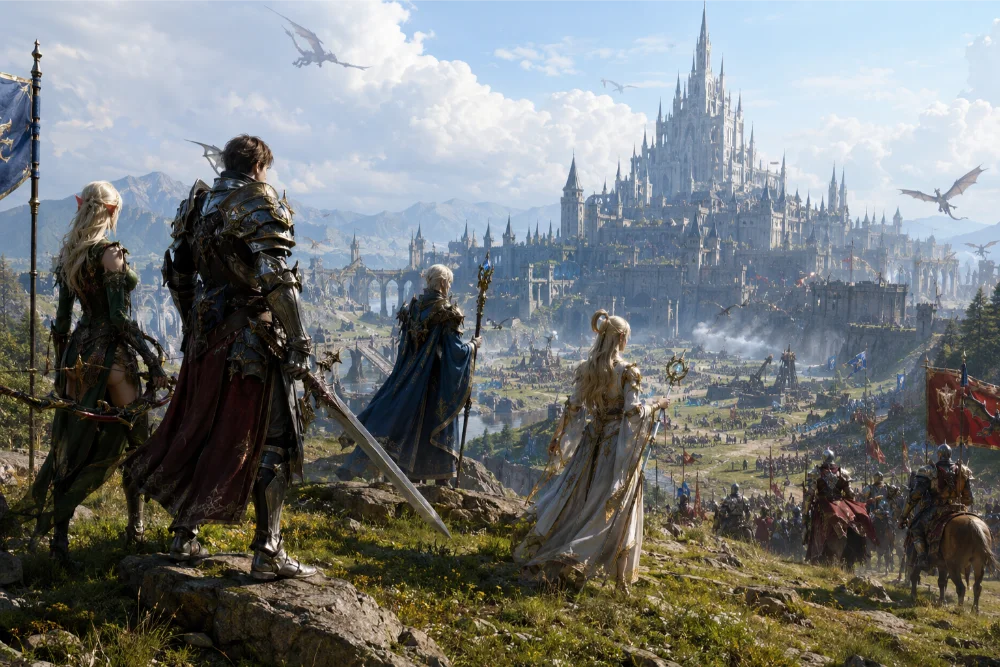
Why Lineage 2 Is Still Popular
Lineage 2 survives because it preserves something many modern MMORPGs soften: consequences. Progress matters, equipment feels earned, and the people around you can change an evening. A rival clan at a hunting spot may force a fight, a retreat, a negotiation, or a call for reinforcements. That tension makes the world feel occupied.
The game also understands scale. Solo play has its place, yet the strongest memories come from parties, clans, raids, Olympiad matches, and castle sieges. NCSOFT still presents Lineage 2 through clan warfare, boss raids, and territorial competition. Those systems create stories no quest writer can fully script. Players remember who betrayed an alliance and who brought the support class a group needed.
Its age is part of the appeal, not only a weakness. The interface and combat rhythm come from another era, but the design remains readable. Pick a target, understand your role, manage positioning, resources, buffs, debuffs, and timing. When a battle goes wrong, an experienced player can usually explain why. That clarity keeps veterans interested and gives newcomers a system worth learning.
Lineage 2 Classes and Progression
Class identity is one of the game’s strongest features. Warriors, tanks, archers, daggers, summoners, healers, buffers, and offensive mages are not minor variations of one hero. Their usefulness changes with party composition, location, equipment, and objective. A character built for farming may struggle in organized PvP, while a support class that levels slowly alone can become essential in a group.
This is why server choice matters almost as much as class choice. Rates, economy, convenience systems, and the age of the world all affect progression. Players comparing High Five environments can review TheBattleClub Lineage 2, whose current site presents several server rates, a wiki, downloads, community channels, and options for solo and clan play. The useful part is being able to inspect the rules before investing dozens of hours.
New players progress more comfortably when they make a few decisions early instead of copying a random endgame build:
- Choose a role you will still enjoy when farming becomes repetitive.
- Learn which buffs, consumables, and resistances affect that role.
- Join a clan that plays during your usual hours.
- Spend currency on a clear upgrade path rather than scattered items.
- Check how the server handles subclasses, events, and catch-up systems.
Clan Wars and Castle Sieges
Many MMORPGs contain guilds, but Lineage 2 is designed around needing one. Clans provide parties, protection, enemies, knowledge, and long-term goals. They also introduce politics. A strong clan is not automatically the clan with the best-equipped characters. Attendance, leadership, communication, and recovery often matter more than impressive weapons.
Castle sieges are the clearest expression of that design. Attackers and defenders fight over space, timing, routes, and objectives rather than isolated kills. Classes that seem ordinary in casual hunting become decisive. Tanks create pressure, healers preserve momentum, ranged groups punish poor positioning, and support players keep a formation functional. The spectacle is large, but victory often depends on small decisions.
Open-world PvP adds another layer because it is rarely balanced like an arena match. Numbers, preparation, terrain, information, and surprise all count. That can frustrate players used to matched queues. It can also be thrilling. Lineage 2 does not always promise fairness; it offers a world where reputation and organization have weight. For many MMORPG fans, that difference is the point.
Choosing a Lineage 2 Server
A private server can preserve an older chronicle, accelerate progression, rebalance rewards, or add modern conveniences. It can also fade after a busy launch. Before downloading a client, examine visible evidence rather than ranking slogans.
- Published rules and a policy on automation and third-party software
- An active forum, Discord, or another community space
- Transparent rates, event schedules, patches, and server changes
- Working support channels and responses to technical problems
- A plan for old worlds, transfers, merges, or long-term progression
Population numbers deserve caution. A homepage counter may use an unclear definition, while a crowded launch says little about the next month. Check towns, trading areas, party search, clan recruitment, events, and recent community posts during your usual hours. A smaller stable world can offer a better experience than a huge opening followed by silence.
High Five servers remain popular because the chronicle combines established classes with raids, Olympiad competition, clan content, and progression that administrators can adapt to different rates. Modifications are not automatically good or bad. Updated quests may reduce dead time, but careless changes can damage the economy or erase class roles. Serious projects document what they changed and why.
Security matters too. Use a unique password, download files only from official project pages, and read account and marketplace rules before trading. Never assume that practices accepted on one server are permitted on another. A careful setup is less exciting than a siege, admittedly, but losing an account to a reused password is a miserable lesson.
Why Players Keep Returning
Nostalgia brings people back, yet nostalgia alone does not keep a clan online for months. The deeper reason is commitment. A character carries history through equipment, alliances, enemies, titles, and reputation. Even routine farming can connect to a larger plan because the materials, currency, or levels may matter in the next siege or raid.
The game leaves room for specialists. Not everyone must be the loudest damage dealer. Some players study markets, organize parties, lead clans, scout enemies, craft equipment, manage support characters, or master one difficult class. MMORPGs are strongest when different kinds of competence coexist. Lineage 2 has preserved that quality better than many streamlined online worlds.
It is not a universal recommendation. The grind can be demanding, PvP can be harsh, and server quality varies. But players who want social dependence, meaningful rivalry, long-term progression, and battles shaped by preparation still find plenty to admire. Lineage 2 remains attractive because it asks for patience and gives memorable stories in return.