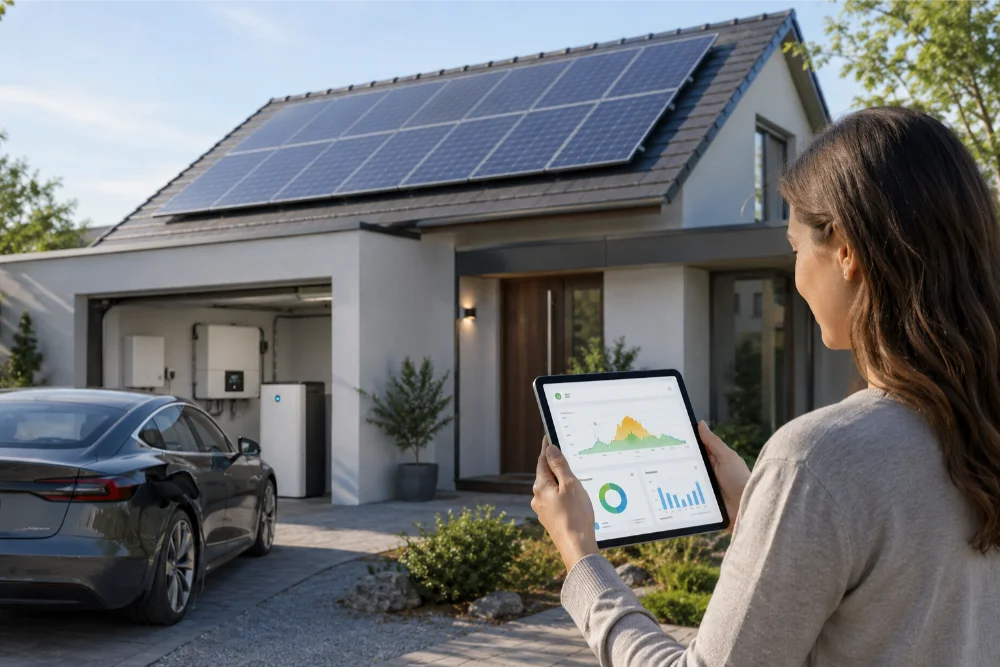
Plenty of solar owners open the production app for the first few weeks, admire the curve, then stop checking. The panels are working, the bill is lower, and the roof is doing its job. So why add another layer of monitoring?
The answer depends on what the homeowner wants to learn. If the goal is only to confirm that the array is producing, the inverter app may be enough. If the goal is to use more solar inside the home, avoid high-priced power, or plan for a battery later, a broader energy view is more useful.
Production Is Only Half the Story
Solar production data shows what the roof made. It does not always show what the house used at the same time. That difference matters because a home can export solar at noon and buy power back at 8 p.m. In places with weaker export credits or time-of-use pricing, that pattern can leave money on the table.
The U.S. Department of Energy recommends estimating appliance and electronics use to understand where household electricity goes. A home energy monitor can make that exercise less theoretical by showing when major loads run and whether they line up with solar production.
For homes considering batteries, EV charging, or smarter load scheduling, anall-in-one home energy system can make the solar conversation broader than panel output. It connects the question of generation to storage, backup, and daily use.
When the Monitor Pays Attention for You
A monitor is most helpful when it changes behavior without becoming another chore. If it shows that laundry usually runs after sunset, the homeowner can shift it earlier. If the EV charges through a peak window, the charging schedule can move. If the battery drains too early in the evening, the reserve setting may need adjustment.
Monitoring also helps spot dull but expensive problems. A failing refrigerator motor, a heat strip stuck on, or a pool pump running longer than needed may not look dramatic on a bill. On a load chart, it can stand out.
Still, monitoring by itself is not magic. A dashboard does not lower a bill unless someone acts on it. That is why solar owners should look for systems that combine visibility with control, especially when flexible loads are part of the home.
The Solar Owner's Worth-It Test
A monitor is probably worth considering if any of these are true: the utility has time-of-use rates, export credits are low, the home has an EV, outages matter, or the household plans to add battery storage. It may be less urgent if net metering is strong, daytime usage is high, and the homeowner is not interested in changing routines.
A practical first step is to compare three curves: solar production, home consumption, and grid import or export. If those curves do not line up well, there is an opportunity to improve self-consumption or plan storage.
For solar owners who want that next layer, Sigenergy home energy storage solutions are worth reviewing because the system is built around solar, storage, EV charging, and app-based energy control rather than monitoring alone.
Solar already answers where the electricity comes from. Monitoring helps answer whether the home is using it at the right time.